Wednesday, July 11, 2012

Pedagogía: Eje I [1° Parcial]

EJE I

  1. Aproximaciones al concepto de Pedagogía.
  2. Su relación con otras áreas de saber que contribuyen al estudio de la educación.
  3. Sus características, categorías y problemas.
  4. Saber pedagógico y conocimiento pedagógico.
  5. La Pedagogía como práctica.
Pedagogía: Una mirada histórica

Es necesario plantear una mirada histórica sobre la Pedagogía para comprender cómo esta disciplina se conformó y construyó vínculos con otras ramas del saber. Dussel y Caruso (1999) señalan que en el principio de la era moderna se diferenciaba al pedagogo, entendido como "el ayo que cría al niño", del pedante, "maestro que enseña a los niños". Hacía 1737, el pedagogo es entendido como guía o conductor. En el año 1788, la Pedagogía se acerca a lo que conocemos como "maestro". Pero no es hasta el año 1996 que aparece el concepto más natural con respecto a la actualidad, el cual define a la Pedagogía como "el arte y ciencia de enseñar y educar a los niños".

1.  Aproximaciones al concepto de Pedagoa

La Pedagogía se encarga de enseñar y educar, siendo esta última una actividad más abarcadora que la de enseñar puesto que educar incluye preceptos acerca de las malas palabras, la sexualidad, los medios de comunicación, etc. mientras que el enseñar se limita a una sólo a situación de enseñanza concreta. Entonces, si bien la Pedagogía tiene mucho que ver con la escuela, es cierto que también la excede.

La Pedagogía es tanto un saber sistemático (ciencia) como un saber más localizado, específico, informal (arte). Por un lado pretende se una ciencia que se pueda probar con métodos de validación y estándares compartidos. Pero por otro lado, la Pedagogía es un arte si por arte entendemos una estructuración personal, una sintonia específica con la situación que se tiene adelante.

La complejidad del proceso educativo ha planteado durante mucho tiempo si sólo la Pedagogía debe ocuparse del estudio de la educación o si existen varias ciencias con ese objeto. En este respecto, existen tres posturas: 1) Un grupo afirma que la Pedagogía es la única disciplina merecedora del nombre de "ciencia" y que las demás son ramas de ellas; 2) Otro grupo de autores, considera a la Pedagogía como la ciencia principal acompañadas por otras "ciencias de la educación" que no tienen carácter independiente con respecto a la primera; 3) Un tercer grupo admite la existencia de diversas ciencias de la educación con carácter definido e independiente, pero con un objeto compartido el cual es la educación que es atendida desde un punto de vista distinto por cada una de ellas.

2. Relación de la Pedagogía con otras áreas del saber que contribuyen al estudio de la educación

Es necesario plantear una mirada histórica sobre la Pedagogía para comprender cómo esta disciplina se conformó y cómo construyó vínculos con otras ramas del saber.

Durante mucho tiempo se ha indagado si solamente la Pedagogía debe ocuparse del estudio de la educación o si existen otras ciencias con este objeto. Un caso concreto se da después de la segunda guerra mundial, ya que por entonces, las Ciencias Humanas coincidían en que la educación debía ser un espacio propio de sus respectivos campos de estudios. De este modo, las Ciencias Humanas integraron a sus disciplinas cuestiones que eran tradicionalmente estudiadas por la Pedagogía, como por ejemplo, el caso de la Psicología que se apoderó de cuestiones como el rendimiento escolar.

A estas subciencias provenientes de la Pedagogía, cuyo punto en común es la educación, se las denominó Ciencias de la Educación. Esta designación hace referencia a un conjunto de ciencias y disciplinas propias e independientes de la educación, cuyo estudio se basa en los fenómenos propios del campo educativo.

En la actualidad, la relación entre la Pedagogía y las otras ciencias tiene aún un valor importante. En este contexto, se plantea un lo denominado como concepto de frontera, cuyos aportes generan diversos enfoques y perspectivas que enfatizan la necesidad de adoptar no solo teorías únicas, sino también una relación entre diversos enfoques teóricos.

3. Características, categorías y problemas

Categorías

> Los fines de la educación
Según Zambrano Leal los discursos Pedagógicos siempre remiten a los fines procurando una explicación que se fundamenta en el por qué y para qué enseñar. En este marco la educación es vista como la encargada de la formación de las nuevas generaciones y como proceso de humanización, logro de autonomía, inteligencia y solidaridad. A su vez, la Pedagogía se propone a develar los fines de la educación, oponiéndose a la transmisión de los saberes sin sentido, asumiendo al aprendizaje como una cuestión de filosofía, política y cultura a la enseñanza como espacio para la formación crítica del estudiante.

> Los sujetos
Rousseau en su obra Emilio instala al niño como principal sujeto de la Pedagogía, el cual es un ser diferente del adulto, razón por la que debe ser educado acorde a sus características y posibilidades. Narodowski argumenta que al final de la edad media apareció´una nueva sensibilidad hacía el niño haciendo que éste sea infantilizado: se lo empieza a cuidar y vigilar más. De este modo se define el destinatario principal y por tanto una categoría central en el estudio de la Pedagogía. Más contemporáneamente se incorporaron el adolescente, el adulto y la tercera edad como sujetos de la Pedagogía. Por último, el docente también es un sujeto.

> El vinculo pedagógico
El vinculo pedagógico implica, por un lado, una conexión con el otro, pero también implica forzar el comportamiento del sujeto para promover su promoción. Ésta es una relación asimétrica ya que el docente posee una autoridad basada en un conjunto de saberes que el alumno no tiene. No obstante, en la dinámica de esta relación existe una fomentación del dialogo debido a que la enseñanza se sustenta de un proceso de comunicación. El vinculo debe estar forjado con bases de comprensión mutua, disposición a escuchar, a poner a prueba y recorrer nuestras limitaciones y prejuicios.

Basabe y Cols expresan que la enseñanza involucra un encuentro humano porque enseñar es participar del proceso de formación de otra persona, tarea que sólo puede hacerse en un sentido pleno con ese otro. En este marco, el otro es un sujeto libre que puede incluso resistirse a los intentos de influencia que sobre él se quiere ejercer.

> La transmisión
La transmisión caracteriza y da sentido al vínculo pedagógico. Diker señala que la transmisión ofrece una herencia, la cual puede ser transformada, resignificada y hasta manipulada en el plano de la cultura de tal forma que represente una dinámica de continuidad/discontinuidad, conservación/cambio en el individuo o en lo social.

Los lazos culturales son el resultado y efecto del proceso de transmisión los cuales no podrían forjarse a no ser de ésta. Dentro del campo de la Pedagogía, ese lazo social se ve en uso en la educación escolar, que surge con la modernidad y resuelve el problema de la transmisión a escala masiva.

> El orden institucional
Según Zambrano Leal la Pedagogía es un saber que esta encarnado en los dispositivos, los cuales son entendidos como la acción de la institución, del sujeto, de la verdad. A su vez, un dispositivo es el objeto, el método, la técnica del discurso con el que la Pedagogía se propone a enseñar en el marco de la escuela.

> El método
Según Rousseau hay una estrecha relación entre la concepción del hombre y el método. Es decir, la cuestión del método de enseñanza ha sido presentado desde la forma en cómo se conoce al hombre. El método es el soporte de la Pedagogia como soporte de saber concreto, sin el cual, ésta no existiría.

Características

> Carácter normativo y prepositivo
Según Pasillas el discurso pedagógico se compone de dos tramas: una argumentativa y otra prepositiva las cuales se orientan a superar la educación existente conforme a lo que se considera deseable para el individuo y la sociedad.

A través de la normatividad la Pedagogía se propone a responder el por qué y para qué estudiar, qué medios utilizar, con qué recursos, cómo organizar un proceso educativo. La Pedagogía centra su discurso en cómo debe ser la educación y en el cómo conseguir que lo sea.

> Sistematicidad
Partiendo de planteamientos Kanteanos, la Pedagogia es sometida a un proceso de construcción de sistematicidad, ya que como Kant decía, la educación que procede mecánicamente ha de contener errores por no tener en qué fundarse. Esta sistematicidad permitía definir principios de agrupamiento en las relaciones interdisciplinarias que pueda establecer la Pedagogía con otras disciplinas.

Problemas

> Discursividad
El discurso es el campo de aplicación de la práctica pedagógica con la cual se explican los fenómenos de la educación. Para Furlán el discurso pedagógico es el que da cuenta de la valorización del reconocimiento y condensación máxima de la jerarquía de la educación. La discursividad registra objetos de saber, nociones, conceptos, modelos, métodos que dan cuenta de la búsqueda de la sistematicidad de la Pedagogía.

> Historicidad
Una mirada retrospectiva es importante en el sentido que a partir de postulados clásicos se pueden construir nuevas formas de pensar la Pedagogía. Por otra parte también permite advertir la complejidad de la Pedagogía al verse influida por acontecimientos políticos, económicos y también teóricos y conceptuales.

> Científicidad
Echeverri y Zuluaga señalan que a causa de la crisis y retos actuales, las maneras de pensar la Pedagogía y formas de investigar las cuestiones pertinentes a ésta, han cambiado. En la actualidad se plantea la importancia de conceptos de frontera cuyos aportes generan diversos enfoques y perspectivas. En consecuencia, la necesidad de actualizar un campo conceptual no apunta a teorías únicas, sino más bien a comprender una configuración que capta las diferencias, relaciones, posibilidades, continuidades entre diversos enfoques teóricos.

4. Saber pedagógico y conocimiento pedagógico

El saber se diferencia del conocer porque en el primero se encuentra una actitud, una práctica y una disposición marcadamente diferente. Mientras que el saber es espontaneo y resulta de inquietudes y prácticas, el conocer se fundamenta sobre el método. El conocimiento procede de operaciones intelectuales complejas, reglas y pretende conformar una finalidad instrumental. Por otro lado, es por medio del saber que se explica el conocer.

A diferencia del conocer, el saber no es una cuestión rígida, por el contrario, en este yacen los matices que diferencias, por ejemplo, a dos profesores de matemáticas. Aunque dos personas hayan estudiado de un mismo libro, sus saberes, que en cierta medida evocan experiencias propias, dictarán la forma en que dichas personas interpreten un conocimiento en particular, que luego es "encasillado" en el esquema mental del individuo.

5. La Pedagogía como práctica 

ljkl


La Pedagogía como única ciencia de la educación


A partir de la influencia del Iluminismo sobre la Pedagogía, sus representantes eran proclives a ver la Pedagogía como la única ciencia de la educación. Un punto de partida de donde la pedagogía empieza a considerarse como una ciencia se da en el Siglo XVIII con la obra de Comenio, Didáctica Magna, en donde se puede observar la discursividad y las prácticas de enseñanza que articula una forma de ser del maestro y un modo de aprender, el cual sería en un espacio determinado al que se denomina escuela. De este modo la discursividad desplaza la enseñanza del libro.


Por otra parte, Pestalozzi también concibe a la escuela como espacio para la enseñanza, como así también, una dimensión de experimentación. Bajo el concepto de enseñanza, Pestalozzi abarcó la educación, el método y la formación del hombre en un marco de diálogo psicológico y social. Rousseau, por el contrario, no se detiene en el concepto de escuela, pero acentúa la figura del niño como destinatario de una Pedagogía adaptada a sus intereses y particularidades, puesto que consideraba que no se educaba para un oficio, sino para ser hombre.
Comenio había pensado en la escuela, y Pestalozzi hace de la educación un concepto social. Rousseau hace de la enseñanza un proceso social y de formación del hombre (Zuluaga Garces)
Kant consideraba que las artes más difíciles eran la de gobernar y educar a los hombres dado que estos no estaban dotados de instintos con esa función. Sin embargo, sostuvo que el hombre era la única criatura que requería educación, cuidado, disciplina e instrucción.

Tomando los aportes de Kant, Herbart, de forma categórica, sistematiza el conocimiento pedagógico sentando las bases que marcan el limite entre la Pedagogía y la Filosofía. Su propuesta en la Pedagogía tiene como objetivo la educación del hombre, la cual puede lograrse a través de tres acciones esenciales:
  • Gobierno: conservación del orden exterior del niño mediante la vigilancia, la autoridad, el amor y la satisfacción de necesidades.
  • Disciplina: el orden interior del niño que se consigue a través de la responsabilidad
  • Instrucción: adquisición del conocimiento que en el proceso de conseguirlo entran en juego el gobierno y la disciplina.
Desde el lugar preponderante que le otorga a la disciplina, Herbart desarrolla cuatro pasos formales que posibilitan el aprendizaje.
  • Claridad: el niño tiene que saber qué aprenderá.
  • Asociación: el nuevo conocimiento es asociado con conocimientos previos.
  • Sistematización: el docente complementa el conocimiento adquirido, añadiendo las características del nuevo objeto de estudio.
  • Aplicación: la aplicación de lo aprendido a través de diferentes ejercicios. 
Durkheim advierte la necesidad de construir un saber sobre la educación a través de la implementación de reglas metodológicas que garanticen el carácter científico de dicho conocimiento. En pos de ello, este autor propone la construcción de una ciencia de la educación que es considerada como uno de los fundamentos de la Pedagogía. Esta postura durkhemiana indaga y responde desde un sentido epistemológico cuestiones inherentes a la Pedagogía como ciencia:
  • Objeto de estudio: Los hechos y fenómenos educativos, las prácticas educativas.
  • Vías de indagación: A través del análisis de las condiciones históricas que producen diferentes resultados; la observación y clasificación.
  • Propósito: Dotar de carácter científico al estudio de la educación.
La Pedagogía y Ciencias de la Educación
A finales del Siglo XX, tras la segunda guerra mundial, las Ciencias Humanas coinciden en que la educación debería ser un espacio propio de sus respectivos campos de estudios. De este modo las Ciencias Humanas integraron a sus disciplinas cuestiones que eran tradicionalmente estudiadas por la Pedagogía, como por ejemplo, el caso de la Psicología que se apoderó del estudio de cuestiones tales como el rendimiento escolar. 


A estas subciencias, provenientes de las Ciencias Humanas, cuyo punto en común es su dedicación a la educación, se las denominó Ciencias de la Educación, designación que hace referencia a un conjunto de ciencias y disciplinas propias e independientes que se dedican a investigar fenómenos propios del campo educativo.

La aparición de las C.E y sus efectos en la Pedagogía es interpretada de distintas maneras:
  • Una de ellas reivindica a las C.E. como un avance con un mayor sustento epistemológico. Aunque algunos señalaban que con esta reivindicación, las Pedagogía asume un estatus menos preciso
  • Colom Cañellas y Nuñez consideran que las C.E. posibilitó el aumento y acumulación de conocimientos acerca de la educación, que no se hubiera logrado desde el tratamiento general que les daba la Pedagogia.
  • Filloux sostiene que el paso de la Pedagogía a las C.E. representa un descentración radical de los problemas pedagógicos. Considera que el pedagogo se preocupa por mejorar la práctica educativa, mientras que las C.E. e orientan a la construcción del saber.
  • Otra postura pertenece al grupo de Historia de la Práctica de la Pedagogía (Colombia), quienes sostienen que las disciplinas de las C.E. se ocupan de la educación utilizando nociones y conceptos propios del campo del que pertenecen. De este modo, el grupo señala que el saber pedagógico se ve disgregado y en crisis producto de la multiplicidad de objetos pertenecientes a las nuevas disciplinas.
  • Por otro lado, desde las propuestas  reconstructivas se considera que la emergencia de las C.E. fue enriquecedora para la Pedagogía.

Tuesday, April 10, 2012

Translatology II: 1st Practical Work

Mark Newmark

Cohesion and Coherence

> Cohesion is the structural, syntactical and lexical means by which we relate parts of a sentence in a text so that they fit together well, forming a united whole.
  • Structural cohesion: (1) standard paragraph structure;  (2) clause and phrase level parallelism; (3) theme/rheme relations between sentences.
  • Syntactic cohesion: (1) reference: anaphoric, cataphoric, exophoric, pronouns, demonstratives; (2) substitution; (3) ellipsis; (4) reiteration / collocation; (5) conjunction.
> Coherence is the quality that makes a text semantically meaningful, as well as makes it pleasing to read because all the parts fit together well and logically.

Intertextuality

Intertextuality is the way in which we relate textual occurrence to areas of our previous textual experiences. These areas are called intertexts, which in one sense, are viewed as a reference to a previous text.

The use of intertextuality shows that texts are never totally original or particular to a given author as they always depend on previous texts. Intertexts may take the forms of imitation, plagiarism, parody, citation, refutation, or transformation of texts.

Contratextuality: It is an aspect of intertextuality in which writers or speakers systematically employ opponent's discourse for their own purposes. Thus, a politician may borrow an element from an opponent's ideology in order to strip it of what it genuinely stands for.

Text Styles

Narrative: It is a sequence of events, where the emphasis is on the verbs
Description: It is static, with emphasis. There are lots of linking verbs and adjectives as well.
Discussion: It is a treatment of ideas.
  • Argumentative text: The dominant function of the text is to steer the situation a a favorable manner to the text producer's goals.
  • Expository text: The focus is on providing a detached account of a situation.
Instructional: There is an attempt to regulate through instruction the way people act or think.

The Readership

The usual type of readership aimed by the average text for translation tends to be an educated, middle class one in an informal, not colloquial style.

These features of the ST readership or recipient mist be elicited by the translator and then matched against those of the TL readership. Since there are always differences between the ST and the TL readership, the adaptation of said features is of significant importance.

Language Function

> Expressive Function: Here, utterances are used to express feelings. This function is usually used in:

_ Serious imaginative literature: poetry, short stories, novels, plays.
_ Authoritative statements: These are text of any nature which derive their authority from the high status or the competence of their authors. Such texts have the personal "stamp" of their authors, although they are denotative, not connotative. Examples: political speeches, legal documents, etc.
_ Autobiographies, essays, personal correspondence.

> Informative Function: This function gives emphasis to the external situation, the reality outside the language. Its formats are usually textbooks, articles in newspapers, scientific papers, etc. Additionally, the informative function may take a form with any of the following features:

1. A formal, non-emotive, technical style for academic papers, characterized in English by passives, present and perfect tenses, literal language, jargon, empty verbs, no metaphors.
2. A neutral or informal style with defined technical terms for textbooks, characterized by the first person, plurals, present tenses, dynamic verbs, and basic conceptual metaphors.
3. An informal, warm style for popular science or art books, characterized by simple grammar structures, a wide range of vocabulary to accommodate definitions and numerous illustrations.
4. A familiar, non-technical style for popular journalism, characterized by surprising metaphors, short sentences, unconventional punctuations and colloquialisms.

> Vocative Function: The core of this function is the addressee as he/she is the object on which the text in intended to persuade. Their acting, thinking or feeling is the vocative text's primary concern. Something that characterizes vocative texts is:

_ First: the relationship between the writer and the readership, which can be seen in the different ways the grammar is employed or the forms of addressing the reader. For example, the pronoun usted in Spanish, or the use of imperatives, infinitives, subjunctives, passives, first or family names; tags, such as "please". All these grammatical devices play their part in determining asymmetrical or symmetrical relationships, if power of equality prevails, if its a command, a request or persuasion.
_ Second: The language must be immediately comprehensible to the readership. This for translation, the linguistic and cultural level of the SL text has to be reviewed before it is given a pragmatic impact.

Stylistic Scales

Scales of Formality
  • Official: sophisticated type of language used in legal documents.
  • Formal: The use of words from Latin rather than phrasals.
  • Neutral: It is normally understood by the average reader, yet some expressions may not be found in every day speech.
  • Informal: There is use of phrasal verbs, contractions and every day language.
  • Colloquial: Language used among friends; very informal.
  • Slang: It is a language used by a specific social class, which may sound rude to many people.

Scales of Difficulty

  • Simple: The vocabulary and structure are simple and easy to follow.
  • Neutral: Here, a basic vocabulary is used, and the average reader is able to understand it.
  • Educated: Words from Latin are used and it is probably not accessible to an uneducated reader.
  • Technical: It is only accessible to experts and specialized people on a given subject

Emotional Tone

  • Intense: There is a profound use of intensifiers, abundance of adverbs, adjectives, etc.
  • Warm: It denotes the presence of the author's feelings towards the subject.

Monday, December 19, 2011

Lengua Española I: Final

Oración: Según la RAE la oración es la unidad más pequeña de sentido completo en la que se divide el habla real.

Aposición
1. explicativa (excluible; entre comas)
2. especificativa (inexcluible; sin comas)

"Lisboa, la capital de Portugal..." [aposición explicativa]
"El Rey Felipe II" [aposición especificativa]

Complemento de régimen
El complemento de régimen es desempeñado por un sintagma preposicional que cumple dicha función cuando el verbo que lo antecede rige una preposición: depender de, atreverse a, contar con, insistir en, etc. 

"La decisión [depende NGV] [de él. CR]"

El complemento de régimen a diferencia de un complemento circunstancial no puede suprimirse.

Complemento predicativo
1. obligatorio (con verbos copulativos: ser, estar, parecer) "Juan [es NGV] [alto. COMP PRED OBLIG]"
2. subjetivo "La mesa [quedó NGV] [manchada. COMP PRED SUBJ]"
3. objetivo "Ella [llamó NGV] [mentiroso COMP PRED OBLIG] [al hombre. CD]"

El complemento predicativo es siempre llevado a cabo por ADJ o SUS.
CD siempre puede ser reemplazado por "lo".
CI siempre puede ser reemplazado por "le".

Perífrasis verbal
1. de infinitivo
a) incoativas (acción que comienza)
b) terminativas "dejó de leer."
c) de intención "quiero llegar."
d) reiterativas "volvió a llover."
e) obligatorias "tiene que terminar."
f) hipotéticas "debe de temer"
g) modales: poder (posibilidad, habilidad), querer (voluntad), soler (hábito)

2. de gerundio
3. de participio

Construcciones no personales
1. Construcción de infinitivo: reemplaza SUS; puede desempeñarse como SUJ, CD, CI, termino de PRE, complemento de PRE.

2. Construcción de participio: reemplaza ADJ; puede desempeñarse como MD, o complemento PRED.

3. Construcción de gerundio: reemplaza ADV; se desempeña com CIRC.

Thursday, December 15, 2011

Phonetics and Phonology I: Program 2011

Unit 1
  • Introduction to the study of Phonetics and Phonology. R.P. the concept of standard usage.
  • Schwa.
  • The phonetic value of "ed" suffixes.
Introduction to the study of Phonetics and Phonology. R.P. the concept of standard usage.
Once we are introduced to the study of Phonetics and Phonology, we come across different concepts, theory and other matters that we should know. Thus, one of the main points the first chapter of the book by Peter Roach is concerned about is the reason why it is necessary to learn a theorical context about Phonetics and Phonology. The answer that arises is that we do not simply need to know phonemes work, are pronounced or such. As people who will work with the language we need to go deeper in the understanding of the mentioned theorical context.

On the other hand, since it may be one of the first steps towards the learning of Phonetics, it is worth noting the distinction between what is often confused: "accent" and "dialect". The latter refers to a variety of a language which is different from another not only in pronunciation, but also in vocabulary, grammar and word-order. On the contrary, accent is only about differences in pronunciation. 

In respect to R.P, which means received pronunciation, it has to do with the way English is pronounced and taught by teachers of English to people who learn the language as a second one. The reason why it is the model chosen is not because it sounds more pleasant or nothing of the sort, but because it is a model fully described and used in textbooks and by newsreaders in serious B.B.C channels.

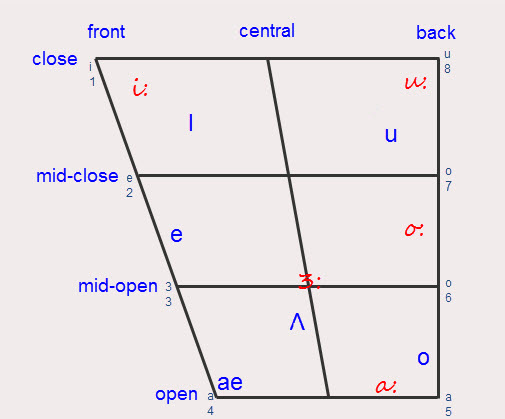
Schwa
Schwa is the most frequently occurring vowel in English. It is associated to weak syllables. Concerning quality, it is a central vowel between half open and half close. Additionally, it is not articulated with much energy. Schwa can occur in initial, medial and final position. 

The phonetic value of "ed" suffixes
The "ed" suffix can occur in regular verbs and adjectives. Verbs in past simple or with its past participle are formed with "d" or "ed" added to its base. This ending is pronounced in one of three ways:
  1. If the "ed" is preceded by a voiceless sound like /p-k-f-θ-s-ʃ-tʃ/ it is pronounced /t/.
  2. If the "ed" is preceded by a voiced sound like /b-g-v-ð-l-m-n-ŋ-z-ʒ-dʒ/ a vowel, diphthong or triphthong, then the "ed" is pronounced /d/.
  3. If the "ed" is preceded by the sound of /t/ or /d/ it is pronounced /ɪd/.

Unit 2
  • The production of speech sounds. Articulators above the larynx.
  • Semivowels /j/and /w/.
  • Phoneme sequence and syllable structure.
The production of speech sounds. Articulators above the larynx
We have a large set of muscles that can produce changes in the shape of the vocal tract. The muscles in the chest produce the air flow that is needed for almost all speech sounds; the muscles in the larynx produce different modifications in the flow of air from the chest to the mouth. After passing through the larynx, the air goes through the vocal tract which ends at the mouth and nostrils.

There are seven articulators above the larynx, which are:
  • The pharynx: It is a tube that begins above the larynx and whose top is divided in two parts. One part is the back of the mouth and the other is the way through the nasal cavity.
  • The soft palate: It allows the air to pass through the nose or through the mouth. The sounds /k/, /g/ and /ŋ/ are made by making use of this articulator. They are called velar sounds.
  • The hard palate: It is a curved surface in the upper part of the mouth.
  • The alveolar ridge: It is a surface covered with little ridges situated between the teeth and the hard palate. There are sounds called alveolar which are made by the tongue touching this place, which are /t-d-n/.
  • The tongue: It is the most important articulator because it can be moved to many different places. We divide the tongue into: tip, blade, front, center, back and root.
  • The teeth: They are located immediately behind the lips. Sounds produced with the tongue touching the teeth are called "dental": /θ-ð/
  • The lips: They are very important in speech. They can be pressed together as for /p-b/ or brought into contact with the teeth as for /f-v/ or rounded for vowels like /uː/. Sounds made with the lips pressed together are called "bilabial", and those with the lower lip making contact with the upper teeth are called "labio-dental".
Semivowels  /j/ and /w/
The sounds /j/ and /w/ are generally called semivowels by many authors. However, some others call them approximates, but what is important to bear in mind is that they are phonetically like vowels and phonologically like consonants.

From the phonetic point of view the articulator of /j/ is practically the same as that of  /iː/, but it is very short. In the same way /w/ is similar to /uː/. Phonologically, we say that /j/ and /w/ are regarded as consonants. In order to illustrate this we can show that words beginning with any of these sounds take the article "a" as opposed to the ones that begin with vowels which take "an". 

The place of articulation for /j/ is in the palate, so it is palatal and /w/ is bilabial.

Phoneme sequence and syllable structure
In every language we find that there are restrictions on the sequences of phonemes. For example, no English word begins with the consonant sequence of "zbf" and no word ends with the sequence of a smiling "a" plus an "h". To say more, no word begins with more than three consonants and no word ends with more than five consonants.

The syllable structure has two parts. One is what we call onset and the other is what we call coda. Onset is the sound before the center of the syllable and coda is the sound after it.

If we break down the onset part we will learn concepts like
  • Zero onset (if the first syllable begins with a vowel) /ɔːðə/ /aʊə/
  • Initial consonants (if the first syllable begins with a consonant)
  • Pre-initial (when a word begins with /s/) /spi:k/
  • Post-initial (when a word begins with a consonant plus any sound of the set /l-r-w-j/ ) /pleɪ/
As well as for the breakdown of the onset part, we can do the same with the coda part.
  • Zero coda (there is no final consonant at the end of the us word: know /nəʊ/)
  • Final consonant (when there is a final consonant: stop /stɒp/)
  • Pre-final (the final consonant is preceded by another consonant: post /pəʊst/)
  • Post-final (It happens when there is a three-consonant cluster and any word of the set /s-z-t-d-θ/ is preceded by two consonants; pre-final and final consonant: helped /helpt/; seventh /sevənθ/)
The English syllable nay have the following maximum phonological structure:


Unit 3
  • Vowels and consonants. The cardinal vowel system.
  • The structure of a syllable.
  • Symbols and transcription; phonemic and phonetic transcription.
Vowels and consonants. The cardinal vowel system
The most common distinction between vowels and consonants is made from the way they are produced, and therefore we can say that vowels are produced in such a way that there is no obstruction of the air coming from the lungs as it passes through the vocal tract. Consonants, on the other hand, are produced with the air undergoing different sorts of obstruction in its way through the vocal tract.

But as there are some cases of uncertainty, there is another way of distinguishing English sounds, which is by looking at the different contexts and positions in which particular sounds can occur. Studying sounds in this way has shown that there are two groups of sounds with quite different patterns of distribution and these two groups are those of vowels and consonants.

Once the distinction can be seen, it is necessary to know in what ways vowels differ from each others; thus, the first point to consider is the shape and position of the tongue by describing two things: first, the vertical distance between the tongue and the palate, and second, the part of the tongue which is raised highest. In other words, the tongue height, frontness and backness.

In addition, it is worth noting another point which rather than the differences between vowels, it has to do with quality. This is lip-rounding, and there are considered three shapes that the lips can take: rounded (as in "u"), spread (as in "i") and neutral (as in the sound people do when hesitating "er").

On a different note, cardinal vowels are vowels from no particular language. They are standard reference system that represents the range of vowels that the human apparatus can make. They are developed for the sake of classifying the vowels used in a particular language. They show extremes of vowel quality.


The structure of a syllable
Unit 2; point C

Symbols and transcription; phonemic and phonetic transcription
There are differences between phonemic symbols and the phonetics' ones. The former do not have to indicate precise phonetic quality, whereas the latter can give much more accurate details and information.

One advantage of the phonemic method is that it is quick and easy to learn. You can make use of phonemic symbols to transcribe either from a dictation or from a written text. However, the disadvantage is that as you continue to learn more about phonetics you become able to hear a lot of sound differences that you had not been aware of before. These differences cannot be displayed by phonemic symbols but by phonetics' ones.

A phonetic transcription containing a lot of information about the exact quality of the sounds would be called a narrow phonetic transcription, whereas one with only a little more information that a phonetic transcription would be called broad phonetic transcription.


Unit 4
  • Manner and place of articulation.
  • Voicing and consonants. Respiration and voicing.
  • Phonology; the study of the Phonetic system. Phoneme sequences and syllable structure.
F

Voicing and Consonants. Respiration and Voicing
All speech sounds are made with some movement of air. The normal way for producing this air flow is by making use of some of the air stored in the lungs. Therefore, as the rib cage moves upwards, the lungs expand by taking air, and when you allow the rib cage to return to its position, the air expelled can be used for producing speech sounds.

Speech sounds are made by obstructing the air flow in some way. One place where we can make such obstruction is in the larynx, by bringing the vocal folds close to each other. If the folds vibrate we will hear the sound we call voicing.

Furthermore, as the larynx is, let's say the motor of voicing, it is worth giving further explanation about what it is. The larynx's structure is made of two large hollow cartilages which are attached to the top of the trachea. This structure makes the shape of a box inside of which there are two think flaps of muscle called vocal folds. At the back, these folds are attached to a pair of small cartilages called arytinoid cartilages.

If these cartilages move, the vocal folds will move too, producing a very complex range of changes in their position that are important in speech. There are four recognizable states of the vocal folds:
  • Wide part: It is the state the vocal folds are for common breathing and usually during voiceless sounds.
  • Narrow glottis: When air passes through the glottis while it is narrowed, the result is a fricative sound like that of whispered vowel.
  • Position for vocal vibration: When the edges of the vocal folds are touching each other, or nearly touching, the air passing through the glottus will contain vibration. When it happens, little air escapes pushing the vocal folds apart and as the air flow quickly past the edges of the vocals folds, these are brought together again.
  • Vocal folds tightly closed: The vocal folds can be firmly pressed together so that air cannot pass between them. When this happens in speech we call it glottal stop.

Phonology: the study of the phonemic system. Phoneme sequence and syllable structure
Any teacher of English as a second language must be able to diagnose the pronunciation errors made by the students, and to give them means of correcting said errors. This is only possible by having both a theorical and a practical knowledge of phonetics, or in other words th phonemic system.

In spoken English there may be many slight different realizations of the phonemes, but the most important thing for communication is that we have to be able to make use of the full set of phonemes. Therefore it is helpful for learners of English to know broadly the English phoneme inventory.


Unit 5
  • The Phoneme. Complementary distribution and free variation. Suprasegmental phonology.
  • Syllabic consonants. Combinations of syllabic consonants.
  • Styles of pronunciation.
The Phoneme. Complementary distribution and free variation. Suprasegmental phonology
The phoneme directory is an abstract set of units as the basis of our speech. These units are called phonemes and the complete set of them is called phonetic system.

A phoneme is the smallest unit capable of producing a change in meaning. However, sometimes we can pronounce one phoneme in different ways without changing the meaning. When this is possible we deal with allophones, and the word that has two realizations is said to be in free variation. One example of this is the word "bad", which normally is pronounced with a voiceless /b/, but when pronounced emphatically it is uttered with full voicing and the meaning does not change.

There are some other instances in which a phoneme has two realizations, but they are not interchangeable. In other words, a sound cannot occur in the place of the other. For example, there is a /t/ in the word "tea" and in the word "eat", but in the first case the /t/ is unaspirated, while in the other it is aspirated. In both cases the phoneme is /t/ but they cannot switch around. Therefore we say that these sounds are in complementary distribution.

In regard with suprasegmental phonology, we can say that there are many contrasts between sounds that are not only the results of difference between phonemes. Stress and intonation are also important. For example, if we pronounce the word "import" with a stress in the first syllable we treat that word as a noun but in the case when the stress is put in the second syllable, we deal with a verb. Another way of showing contrast between sounds is by intonation. In the word "right" a raising voice while pronouncing it means that we are inviting our listener to answer or continue with what he or she is saying, but if such word has a falling voice, the word is interpreted as a confirmation.

Syllabic consonants. Combinations of syllabic consonants
There are some syllables where no vowel is found. When this occurs we find /l-r-m-n-ŋ/ as the center of the syllable.

Syllables with the sound /l/ as the center are the most noticeable examples of syllable consonants. For example /bɒtl/ /lisn/ /tl/ /kʌpl/ .

Styles of pronunciation
When we speak we do not always speak in the same way, but we use different styles of pronunciation. It is difficult to draw a line between styles of pronunciation, yet we can divide the pronunciation into broad groups.

• formal which is used for specific occasions such as a recitation or in a church.
• unhurried colloquial which is clear, slow and it is the style that appears in dictionaries. It may include elisions and assimilations.
• informal colloquial: it is a rapid style that results of a series of modifications of the ideal forms. These are elisions and assimilation as well. For example, assimilation of d/ to /n/ in good night  /gudnait/ .


Unit 6
  • Stop or plosive consonants
  • The larynx; the vocal folds
  • Writing systems; weakness of English orthography
Stop or plosive consonants
English has six plosive consonants: /p-t-k-b-d-g/ All six plosives can occur at initial, medial or final position. This kind of consonant is produced in four phases.

closure phase: it happens when one articulator is moved against another in order to make a stricture that allows no air to escape.
hold phase: the articulators remain pressed together, so as the air cannot escape it is compressed.
release phase: the articulators move apart in order to allow the air to escape
post-release phase: a sound called plosion can be heard.

For example:
initial position: pop-time-car
medial position: attack-adore-appear
final position: stop-cook-act

The larynx: the vocal folds
The larynx's structure is made of two large hollow cartilages which are attached to the top of the trachea. This structure makes a shape of a box inside of which there are two thick flaps of muscle called vocal folds. At the back they are attached to a pair of small cartilages called arytinoid cartilages.

If these cartilages move, the vocal folds will move producing a very complex range of changes in their position that are important in speech. There are four easily recognizable states of the vocal folds:

wide part: It is the state in which the vocal folds are for common breathing and usually during voiceless consonants.
narrow glottis: when the air passes through the glottis when it is narrowed the result is a fricative sounds.
position for vocal fold vibration: when the edges of the vocal folds are touching each other or nearly touching the air passing through the glottis will cause vibration. When this happens a little air escapes pushing the vocal folds apart and as the air flow quickly past the edges of the vocal folds, the folds are brought together again.
vocal folds tightly closed: the vocal folds can be firmly pressed together so that the air cannot pass between them. When this happens in speech we call it glottal stop.

Writing systems; weakness of English orthography
We can find inconsistencies between English sounds and English spelling, even though it is stated that a writing system should contain one graphic symbol for each phoneme in the language. This is why English has weaknesses in its orthography.

However, although no writing system is perfect, some languages do a better job in that specific area. Spanish, for example, has a very direct correlation between sounds and graphic symbols.

The reason why English has not a clear correlation between sounds and spelling is because the written its form has not changed, but the pronunciation has been changing over the time.


Unit 7
  • English fricative and affricative consonants; their production.
  • Long and short vowels. Classification of vowels.
  • Fortis and lenis.
English fricative and affricative consonants; their production.
Fricatives are consonants with the characteristic the when they are produced, air escapes through s small passage and makes a hissing sound. This sort of consonants are continuant, which means that you can continue making them without interruption as long as you have enough air in the lungs.

There are four voiced sounds /v-ð-z-ʒ/ and five voiceless sounds which are /f-θ-s-ʃ-h/

Affricatives are rather complex consonants. They begin as plosives and end as fricatives. There are only two affricatives which are the voiced /dʒ/ and the voiceless /tʃ/.

Now, concerning the classification of the fricative consonants, we say that:
/f-v/ are labiodental. The lower lip makes contact with the upper teeth.  
/ð-θ/ are dental. The tongue touches the inside of the upper teeth. For example /θʌmb/ /fɑːðə/

/s-z/ are alveolar. The tongue touches the alveolar ridge, and the air escapes through a narrow passage along the center of the tongue. For example /zɪp/ /sɪp/

/ʃ-ʒ/ are palato-alveolar. The place of articulation is partly palatal, partly alveolar. The tongue is in contact with an area slightly further back than for /s/. For example /ʃɪp/ /meʒə/

/his glottal. The friction noise is between the folds. For example /əhed/

Long and short vowels. Classification of vowels.

In English there are seven short vowels and five long vowels. The latter tend to be longer than the first, but the difference is not only length but also quality.

Graphically, the symbols for long vowels consist of one vowel symbol plus two dots, but as the difference between short and long vowels is not only length, it we omitted the two dots the vowel symbols would still be all different from each other. Therefore it's important to know that the length mark made of two dots is used not because it is essential but because it helps learners to remember the length difference.
The short vowels are:  /ɪ-e-æ-ʌ-ɒ-ʊ-ə/


/ɪ/ It's a front, half close vowel. The front of the tongue is raised towards the hard palate and the tonthe height is near the half close position.
/e/ It's a front vowel between the half-close and half-open.

/æ/ It's a front vowel between the half-open and open.

/ʌ/ It's a central vowel and the tongue height is more open than half open.

/ɒ/ It's a back vowel between half open and open.

/ʊ/

/ə/


Thursday, September 15, 2011

Grammar I: Notes 2011; Syntax

Classification of Sentences


The Simple Sentence

It consists of just on main clause that has one finite verb, although it may have other verb phrases that contain other verb forms. For example: "the dog barking the neighbors in ownless."

The Compound Sentence

It consists of two or more main clauses that may be joined in one of three ways:
  1. With coordinating conjunctions: and, but, or, so, yet, for: "She doesn't know how to drive, but she will eventually learn."; "I won't have money til next week, yet I'll get by somehow or other". Sometimes conjunctions are used in pairs to link clauses or smaller grammatical units that are balanced. These types of conjunctions are called correlative conjunctions: either...or; neither...or; not only...but also; both... and; as...as.
  2. With a semicolon (;): Semicolons are used when two independent clauses are linked with no connecting words: "I've changed my mind; I will stay in home."
  3. With a semicolon and a connector: Connectors, often called conjunctive adverbs, are used to connect main clauses to make compound sentences. The principal connectors are: however, therefore, otherwise, moreover, nevertheless, furthermore, hence, also, thus, consequently, besides, accordingly, meanwhile, etc.

The Complex Sentence

It usually connects ideas of unequal importance. They are formed by joining an independent clause with a subordinate clause: "I wanted to sleep when everybody was making noise."

Clause

Subordinate clauses have different functions when related with main clauses. There are three types of subordinate clauses that differ in their functioning:
• Adjectival clauses
• Noun clauses
• Adverbial clauses

Adjectival Clauses: They are used in the same way as a single-word adjective, describing and modifying nouns. It comes immediately after or as close as possible to the noun it describes.
Relative clauses are introduced by the relative pronouns who, whom, whose, which, that and the relative adverbs where, when, and why. The noun modifying by an adjective phrase or clause is called antecedent.
"I saw a house that was very pretty."
Relative clauses are either defining or non-defining. A defining clause cannot be omitted from the sentence without changing the meaning. A non-definining clause gives additional information, but does not define the antecedent; it is enclosed by commas. 
*The relative pronoun that is used only in defining clauses, and along with the other relative pronouns except of whose, might be omitted if possible.
> Reduction of relative clauses.
There are three common ways to reduce and adjective clause beginning with who, which,  or that (used as subject of the sentence) to a phrase.
  1. Omitting the relative pronoun and the be form of the verb: "The woman (who is) cooking is my mother"; "the dog (which is) barking outside belongs to her"; "The country (that is) in crisis in Greece."
  2. In clauses that do not contain a form of be, it is usually possible to omit the pronoun and change the verb to its ing form: "The person (who knows/knowing) how to use a computer will get the job."; "The book (that has/having) 100 pages ins mine"
  3. Some adjective clauses can be reduced to appositive phrases. "Combat sports, (which are) my favorites ones, are not as popular as other sports in my country"; "My brother, (who is) aged 13, plays soccer in B.S."

Adverbial Clauses: They have a large array of functions within the sentence, which answer different questions, such as when, how, why.
> Time: Before, after, until, when, whenever, as, since, till, as soon as, etc: "After you leave, check if you have everything you need."
> Place: Where, whenever, anywhere, everywhere, elsewhere: "I like where we went yesterday."
> Reason: Because, since, as, given: "Since I know you too well, I imagine what you re going to do."
> Purpose: So that, on order that: "I won't take a nap, so that I go to bed early tonight."
> Manner: As, as if, as though, like, the way: "Feel as if this were you home."
> Condition: As long as, in case, provided that, unless, whether or not, if: "I'll do it provided (that) you pay me."; "I'll do it whether he pays me or not."; "As long as he pays me, I'll do it."
> Result: So...that; such...that: "He was so tall that he could change a bulb without a ladder."
> Contrast: Although, though, even though, while, in spite of the fact that: "I love listening to music although I don't have much time to do it."

Noun Clauses: It is used in the same way as a single-word noun. It consist of a subordinate conjunction, a subject an a verb. They occur frequently when we present out own thoughts or report on the ideas of others. Noun clauses are introduced by subordinating conjunctions: that sub, what, how, when, whether, if, where, why.

>Functions of noun clauses
subject of a sentence: "what she wears is never old-fashion."; "what they have done is unfair."
object of a sentence: "you reap what you sow."; "they will say that it was not their fault."
object of a preposition: "have you thought of how you'll do it."; "I don't believe in what the book says."
apposition to a noun: "the condition, that we have to pay him, is not fair."; "the likelihood, that it will rain, is high."
complement of a verb: "the kid became what he wanted to be."
adjective complement: "I'm sure that you can do it"; "she's not aware that her behavior will make her regret."
*That can be omitted when it introduces a noun clause as object of a verb, or in other words, when it is not subject of said clause.

Conjunctions

It is a word that joins together other words, phrases and sentences. There are two general clauses of conjunctions: Coordinating conjunctions and subordinating conjunctions.

> Coordinating Conjunctions: They join sentences of equal importance or two words that stand in the same relation to some other word in the sentence. There are different kinds of conjunctions:
• Cumulatives: They add one statement to another (and, both...and, not only...but)
• Alternatives: They represent a choice between two options (or, otherwise, either...or)
• Adversatives: They contrast one statement with another (but, yet, however, nevertheless)
• Illative: They infer one statement from another (so, therefore, consequently)
• Explanatory: They explain one statement by means of another (for)

> Subordinating Conjunctions: They join together sentences of unequal value. The most commonly used Subordinating conjunctions are: that, where, whom, while, before, until, if, after, since, because, (al)though, unless, as.

There are other connectives, which are not conjunctions, that are used to introduce subordinating clauses. These connectives are relative pronouns or relative adverbs: that, which, who, where, etc: "He's the man who I want to see."

Conditional Sentences

> Zero Conditional: It refers to conditions that are always true, with automatic or habitual result.
  • if + present simple, present simple;"If the moon gets closer to the Earth, the tides rise."
> First Conditional: It expresses possible conditions, probable results as well as other functions as threats, warnings, offers, etc.
  • if + present simple, will + bare infinitive; "If you don't harry up, they will leave without you."
  • If can be replaced by unless or in case of.
  • Will can be replaced by can, should; bare infinitive; going to.
  • The present simple in the "if" clause can be replaced by the present perfect.
> Second conditional: It expresses a hypothetical condition and its probable result. In same cases, the condition is possible in theory but improbable in practice.
  • if + past simple, would + bare infinitive: "If petrol were free, I would drive up to Alaska."
  • In the if clause, when there is a negative verb, then if can be replaced by unless.
  • Would can be replaced by could or might.
> Third Conditional: It expresses a imaginary situation about the past; actions that happened in a way which is impossible to change now.
  • if + past perfect, would + past perfect: "If I had known she was an spy, I wouldn't have fallen into the trap."